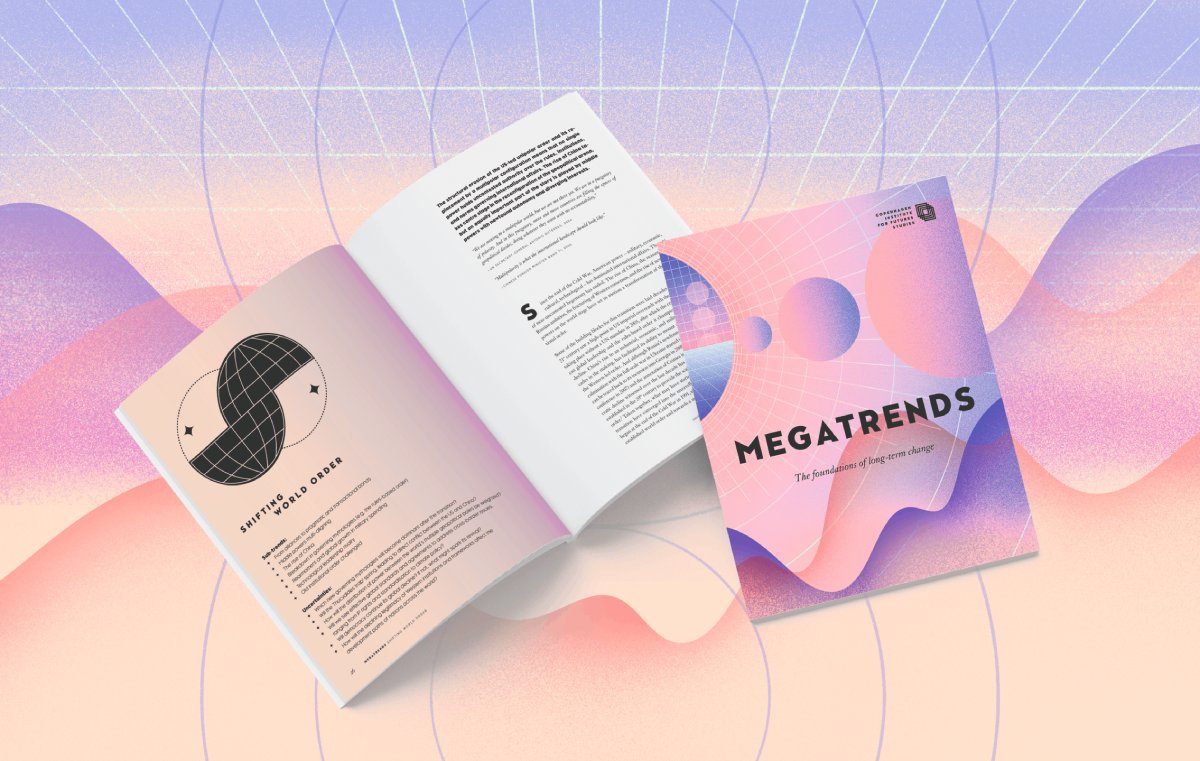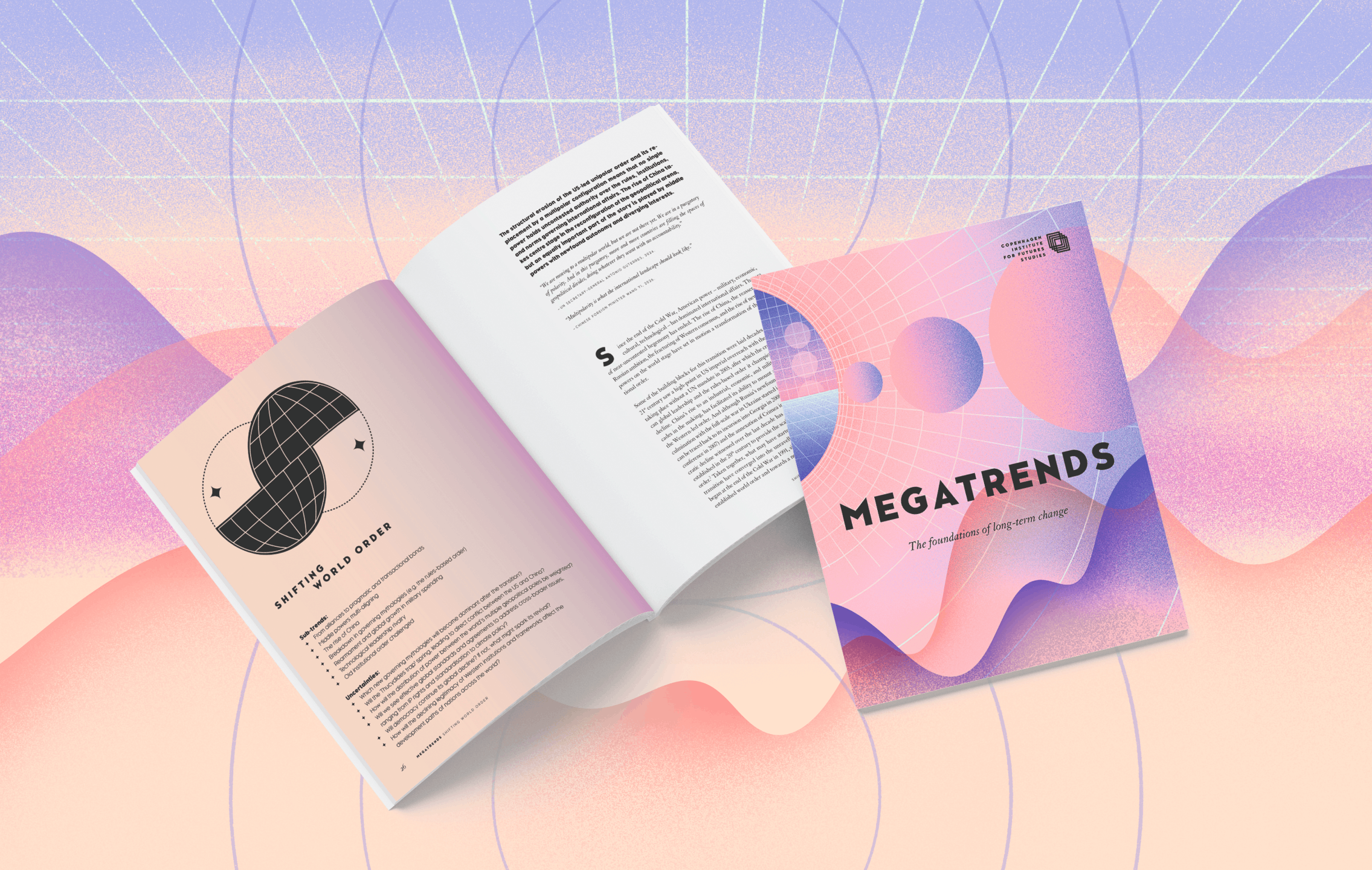

CIFS' 11 Megatrends
CIFS arrived at 11 structurally distinct megatrends that span geopolitics, economics, demographics, climate and sustainability, social life, health, technology, infrastructure, and urbanisation. Together they provide a coherent picture of many of the major transformations shaping our societies over the long term.
1. Shifting World Order
The structural erosion of the US-led unipolar order and its replacement by a multipolar configuration means that no single power holds uncontested authority over the rules, institutions, and norms governing international affairs. The rise of China takes centre stage in the reconfiguration of the geopolitical arena, but an equally important part of the story is played by middle powers with newfound autonomy and diverging interests.
“We are moving to a multipolar world, but we are not there yet. We are in a purgatoryof polarity. And in this purgatory, more and more countries are filling the spaces ofgeopolitical divides, doing whatever they want with no accountability.”
UN Secretary-genal António Guterres, 2024
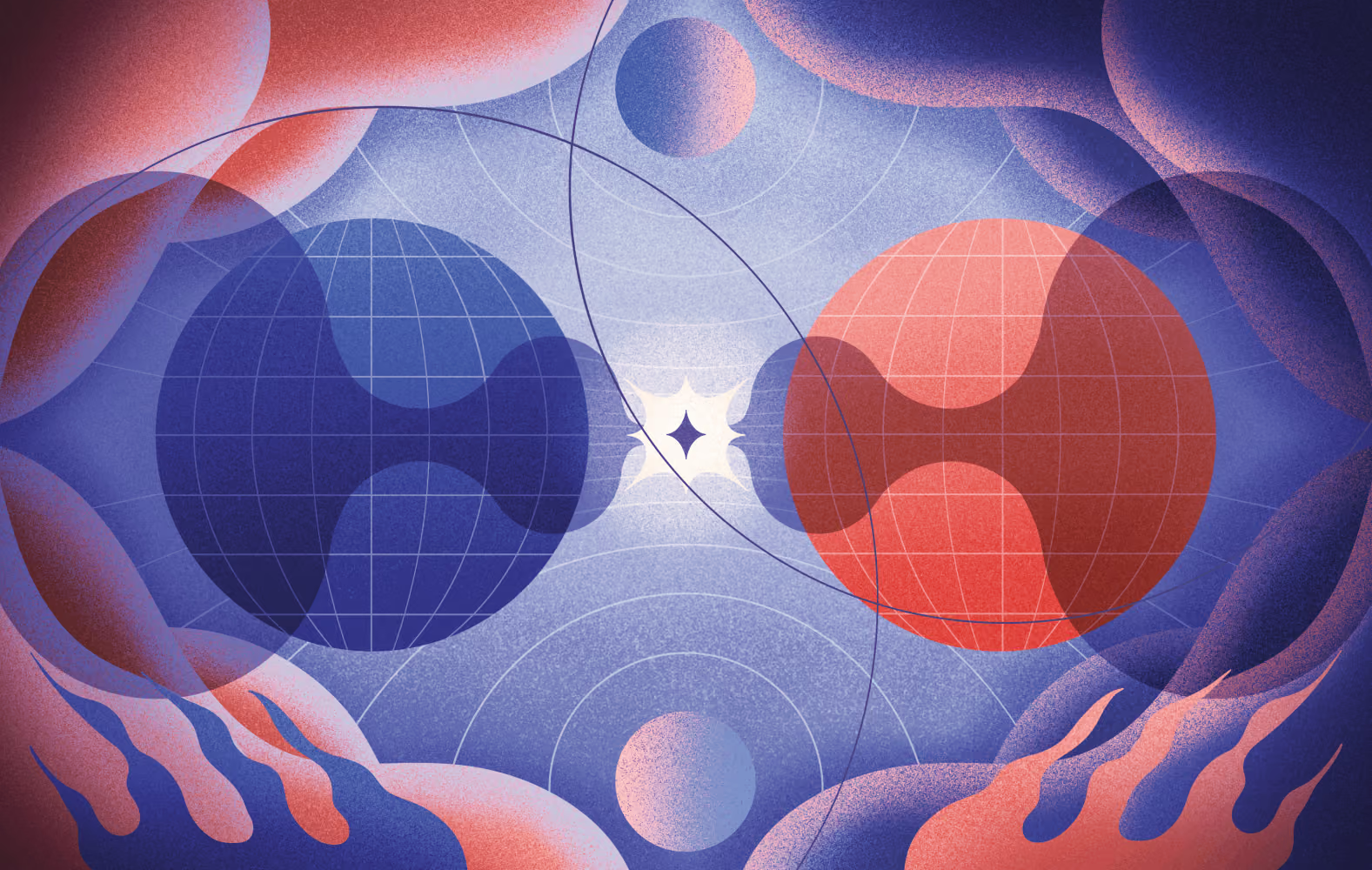

2. Inversion of the Population Pyramid
The global population is being fundamentally restructured through a shift from youth-heavy to increasingly senior-heavy societies, driven by sustained fertility decline and longer lifespans.
This transition is universal in direction but uneven in pace. Some countries are already experiencing rapid ageing and population decline, while others still face continued population growth and younger age structures for decades to come.
The result is a period where ageing, shrinking population, and youth expansion coexist globally. The knock-on consequences of this demographic inversion extend across societal domains. They strain pension, healthcare, and education systems built for populations that were, on average, younger. They create imperatives for investment in AI and automation to offset a shrinking labour supply. They drive migration flows and affect intergenerational relations. And they shift the political calculus around conflict, innovation, and institutional risk-taking.
“The population of Earth is a lot like the stars. The total population is still growing,
but when we track total increase, we’re looking at the star that seems to be shining
brightly but has already imploded.”
Jennifer D. Sciubba, Expert in Political Demography, 2023.
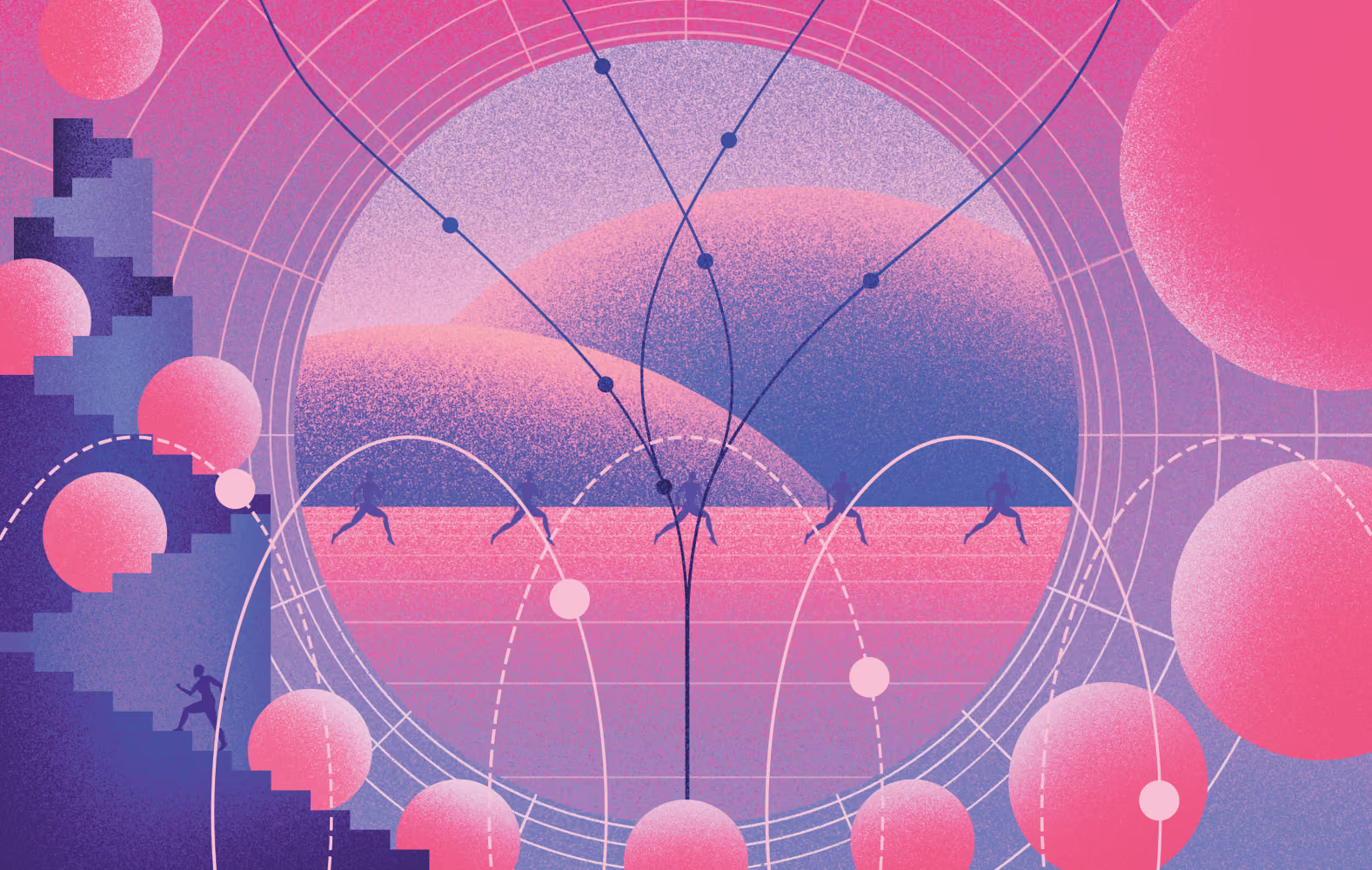
3. The Green Transition
Climate change, ecological degradation, and breached planetary boundaries are forcing a shift away from the fossil-fuelbased, resource-intensive economy of the 20th century.
That shift is increasingly reinforced by economics, as renewables are quickly becoming the cheaper option in many markets. The Green Transition encompasses both the shift to renewable energy and efforts to halt the environmental degradation driven by resource-intensive production.
This transition is underway, but it proceeds unevenly, both in terms of geographies and efforts. Renewable energy capacity is expanding, and CO2 emissions are measurably lower than they would otherwise be, while progress on protecting natural habitats and reducing material consumption lags further behind. Political backlash against sustainability agendas in several major economies creates noise and distracts attention, but it has not reversed the trajectory of the megatrend.
The visible pressures – intensifying climate impacts, worsening ecological degradation, and the economic costs associated with both developments – continue to build. But these dynamics alone are no guarantee that the transition will happen fast enough to avert severely disruptive climate risks.
“We're in a race between the energy transition and massive climate disruption. The
jury's out as to which of those happens first.”
Naomi Oreskes, Historian of Science at Harvard University, 2023.
4. Individualised Everyday Life
As individualisation in its various expressions becomes a worldwide condition, the standardised communal scaffolding of the past is giving way to a manifold, negotiated and self-authored pluralisation of everyday life. Across very different societies the underlying indicators point the same way: smaller households, more people living alone, postponement of marriage and childbirth, and less defined and linear life-phases.
On the level of individual consciousness, identity shifts from something that is given to something that is constructed, maintained, and revised. The forms and expressions of individualisation vary sharply by culture, social structures, and political system, yet its overall direction is unmistakable. This also comes with a cost, in the form of rising loneliness, isolation and social fragmentation.
“The more tradition loses its hold, and the more daily life is reconstituted in terms of the dialectical interplay of the local and the global, the more individuals are forced to negotiate lifestyle choices among a diversity of options.”
Anthony Giddens, Sociologist, 1994

5. Health Beyond the Clinic
Health management is shifting from a matter of communicable disease and acute treatment to one of chronic, long-term management embedded in everyday life. A century ago, infectious disease dominated mortality. Today, non-communicable diseases account for most non-pandemic deaths. This reflects not only ageing, which means people live longer with chronic conditions, but also health outcomes being shaped by people’s environment and circumstance well before they reach a doctor.
The future of health is marked by a series of challenges which include growing self-management (and the inequality in who can do it well), healthcare systems strained by long-term care, and an ageing population whose extra years do not necessarily translate proportionately into extra years of health. New tools like wearables and AI guidance offer partial help but create new risks around reliability, health literacy, and trust. Whether interventions can close these gaps – and how – remains a central question.
“Health does not begin in a hospital or clinic. It begins in our homes and communities, with the food we eat and the water we drink, the air we breathe, in our schools and our work places.”
Dr Tedros Adhanom Ghebreyesus, Who Director-general, 2021.
6. The Rise of Embedded AI
The Rise of Embedded AI represents the shift from AI as a tool to AI as infrastructure. As AI becomes embedded into more facets of our lives, society and the economy, new questions and uncertainties related to the relationship between humans and machines start to appear, highlighting that the shift does not imply one predetermined future. The same developments that augment human capabilities can also deepen dependencies on systems few people fully understand, reshape where the value of knowledge work lies, and raise unresolved questions about retaining cognitive ownership and control as more decisions are delegated to machines.
“It is customary to offer a grain of comfort, in the form of a statement that some peculiarly human characteristic could never be imitated by a machine. I cannot offer any such comfort, for I believe that no such bounds can be set.”
Alan Turing, Mathematician and Computer Scientist, 1951
7. The Biotech Revolution
Biotechnology – the use of living organisms to make products and raw materials – is set to revolutionise the world over the next half-century. It enables us to transcend natural limitations, understand and manipulate genetic codes of plants and animals, create modified crops that are more resilient or require less fertiliser, develop new treatments for hereditary illnesses, and increase life expectancy – perhaps drastically. Over the course of this century, biotechnology will be integrated deeper into nearly all facets of modern society, including healthcare, food production, material design, and energy production.
“I predict that the domestication of biotechnology will dominate our lives during the next fifty years at least as much as the domestication of computers has dominated our lives during the previous fifty years.”
Freeman Dyson, Theoretical Physicist and Mathematician, 2007

8. The Constrained Economy
The global economy is undergoing a structural shift from the expansionary configuration of the post-Cold War era to a more constrained one. Many of the enabling conditions that drove growth, integration, and convergence for three decades have either exhausted themselves or gone into reverse. Lower growth is one consequence of this shift, but the deeper change is the constraints and conditions under which states, companies, and individuals now pursue economic activity.
“We’ve come to learn about new layers in uncertainty. We have uncertainty in the economic fundamentals and what we're now seeing is even uncertainty in what I call the ‘super fundamentals’. Uncertainty, about the legal system, about democracy, about so many fundamental things.”
Sandra Phlippen, Chief Economist at ABN AMRO, WEF Chief Economists Outlook, May 2025o,

9. The New Face of Urbanisation
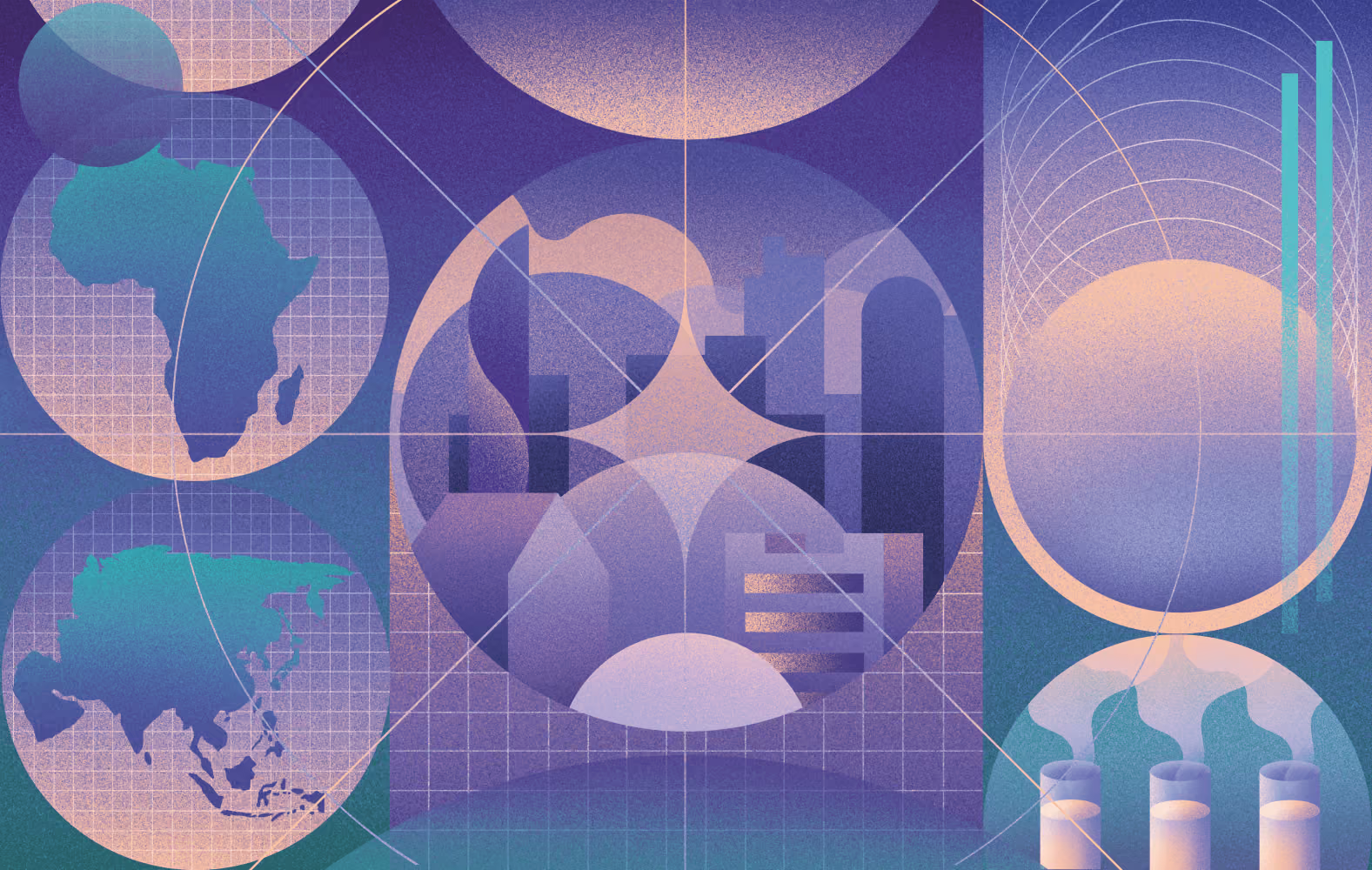
Over the course of this century, urban milieus (primarily in Asia and Africa) will undergo developmental changes with unprecedented speed and complexity. The new urban epicentres will expand faster than institutions can adapt, often at lower income levels, and under demographic, climate and governance pressures that make comparison to any previous wave of city-building difficult. The central question is not only how many people will live in cities, but also what kinds of urban worlds will emerge and who will be included in them.
“Africa will still be young, even at the end of this century. The continent will be dominated by super cities – chaotic and badly planned, no doubt… but also vital and vibrant and bursting with new ideas. We have a hunch that the really exciting music and theatre, the truly groundbreaking innovations, the revolutionary new thinking in the last decades of this century will more likely come from Lagos or Mumbai than from Paris or Tokyo.”
Darrell Bricker and John Ibbitson in “Empty Planet”, 2019

10. Power Through Networks
Power Through Networks describes the long-term shift from territorial, state-centred sovereignty and power towards authority that is distributed, networked, and overlapping. Critical social, economic and security functions increasingly depend on transnational digital infrastructures that no single state controls. Authority is redistributed rather than drained away, since the same networks that put a function beyond one state’s reach can extend another’s.
“When Denmark says that its relations with Google are as important as those with any other state, we should take this as wisdom.”
Benjamin Bratton, Philosopher of Technology, to Farsight Magazine, 2024

11. Concentration of Wealth
Over the course of this century, urban milieus (primarily in Asia and Africa) will undergo developmental changes with unprecedented speed and complexity. The new urban epicentres will expand faster than institutions can adapt, often at lower income levels, and under demographic, climate and governance pressures that make comparison to any previous wave of city-building difficult. The central question is not only how many people will live in cities, but also what kinds of urban worlds will emerge and who will be included in them.
“Wealth inequality is not just very large; it is persistent and self-reinforcing. Over the past three decades, the wealthiest individuals have pulled away at an extraordinary pace; this has also affected the distribution of opportunities and power worldwide.”
World Inequality Report, 2026