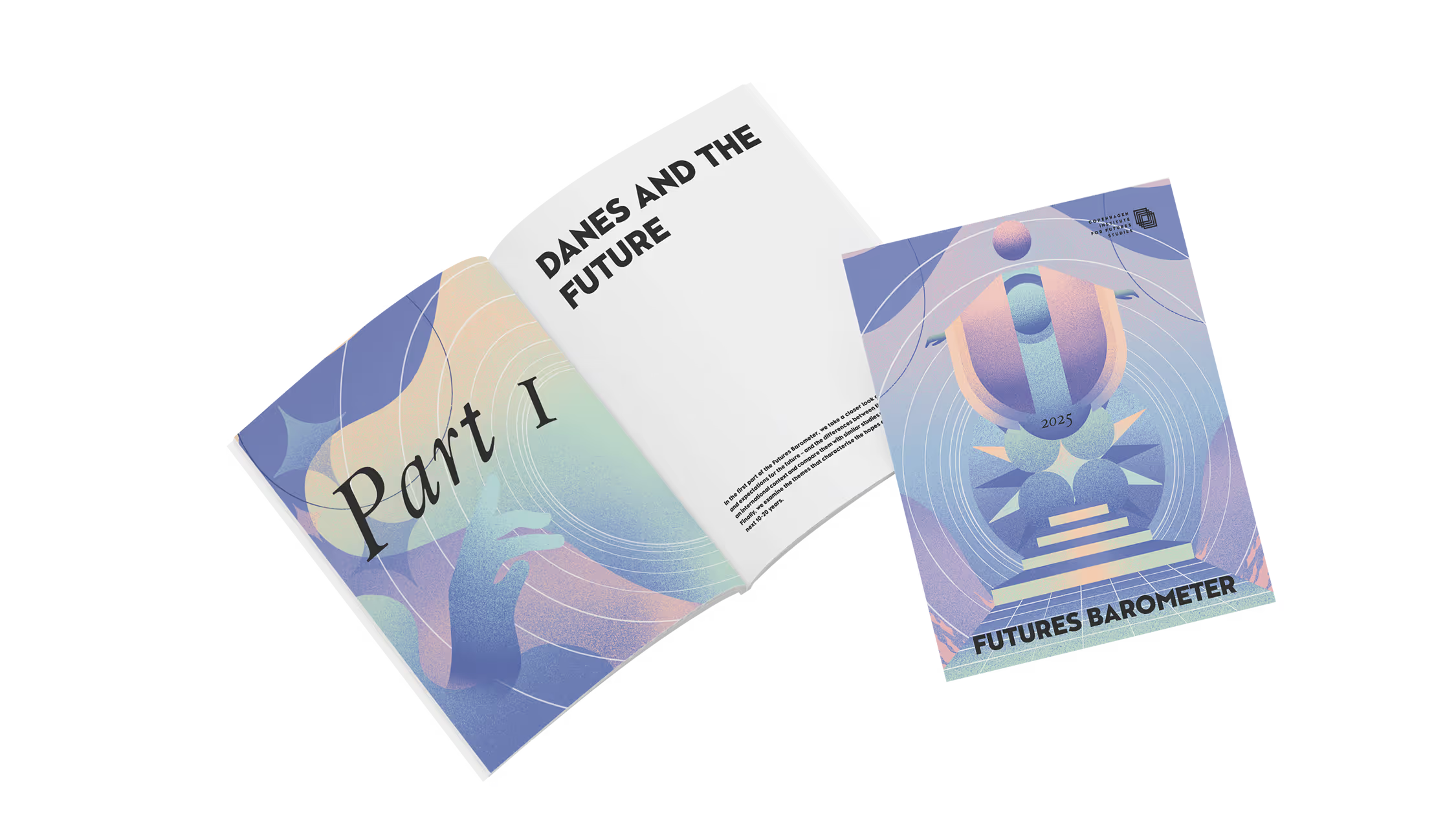
Futures Barometer 2025

Download our survey about Danes' hopes, concerns, and expections about the future

Key Insights

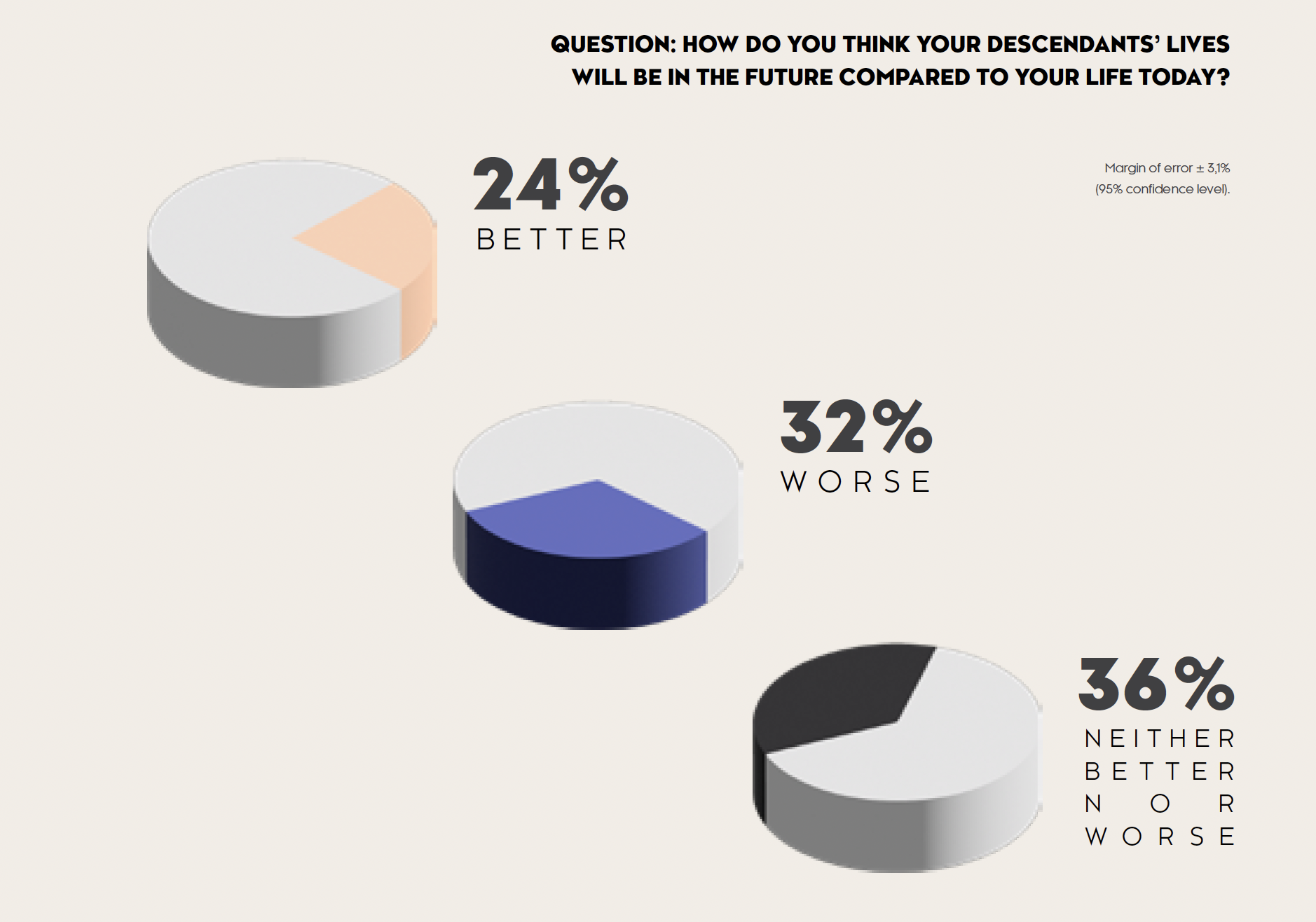
How do you think your descendants’ lives will be in the future compared to your life today?

24%

Better

32%

Worse

36%

Neither

The Futures Barometer 2025 provides insights into Danes’ expectations, hopes, and concerns about the future – both on a personal and collective level – and examines their views on the connection between political decision-making and foresight.
What do Danes think about when they imagine the future?

The Futures Barometer 2025 provides insights into Danes’ expectations, hopes, and concerns about the future – both on a personal and collective level – and examines their views on the connection between political decision-making and foresight.

The Barometer is based on a survey developed by the Copenhagen Institute for Futures Studies (Instituttet for Fremtidsforskning) in collaboration with Epinion.
"We know very little about the images of the future circulating among the public, yet these images – whether pessimistic or optimistic – shape our decisions in significant ways. The Barometer is our contribution to closing this gap in understanding by mapping citizens' concerns, hopes, expectations, and aspirations for the next 10-20 years."

- Casper Skovgaard Petersen, Head of Research

Summary of Results

  • Danes are divided between hope and concern for the future, with a slight preponderance for hopefulness. Half (52%) are hopeful, while a slightly smaller share (43%) primarily view the future with concern.
  • Half of Danes (52%) feel a strong sense of responsibility for the wellbeing of their descendants, while only 10% do not feel any responsibility.
  • Optimism about the future – understood as the belief that our descendants’ lives will be better than our own – is shared by only a minority of Danes in 2025. A quarter (24%) expect a better life for their descendants while a third (32%) expect life will be worse or much worse for them.
  • War and peace are significant sources of concern and hope.
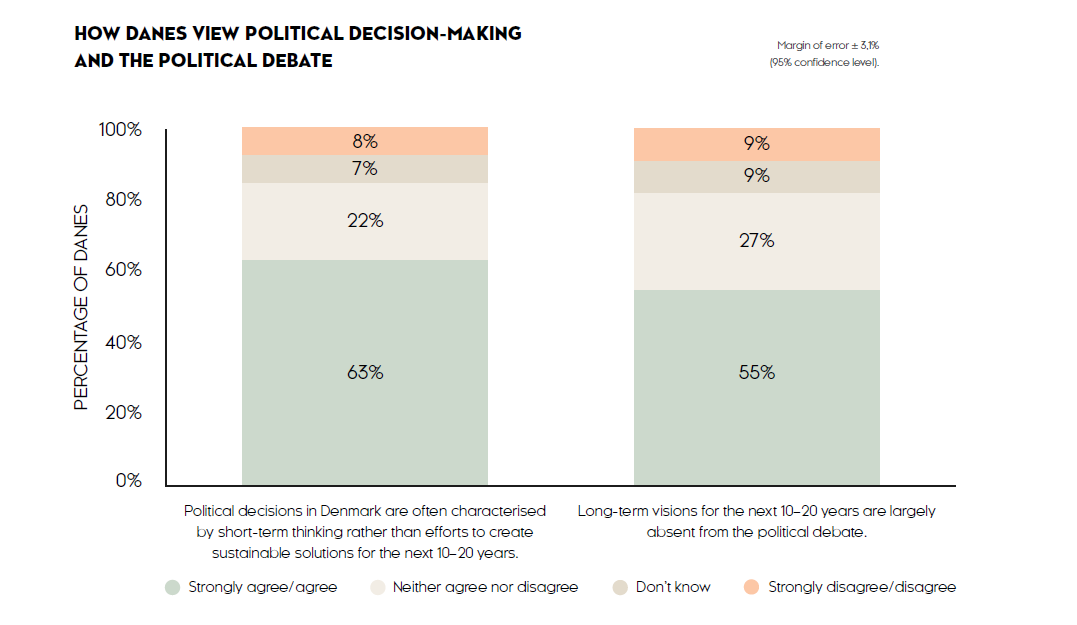
  • Most Danes (64%) believe that political decisions in Denmark are often characterised by short-term thinking rather than efforts to create sustainable solutions for the next 10–20 years.
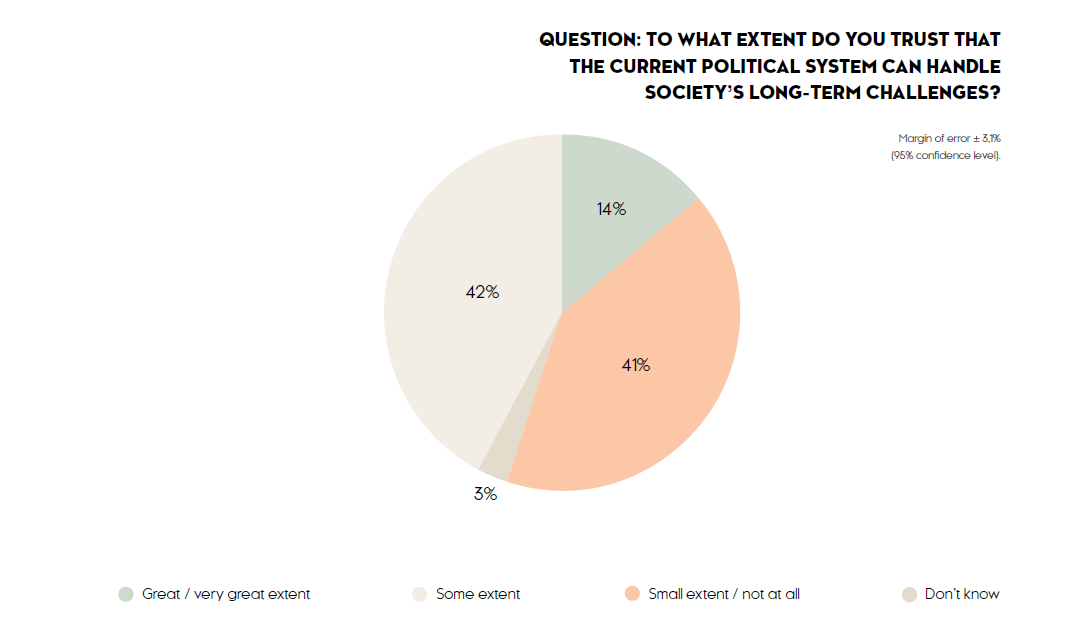
  • Danes are calling for more vision in politics –something 55% believe is lacking in the political debate. Few Danes (14%) have a high level of confidence in the political system’s ability to handle long-term challenges.
  • Danes have a positive view of initiatives aimed at creating a closer connection between political decision-making and foresight.

Content

The Futures Barometer is divided into two parts. The first part examines Danes’ hopes, concerns, and expectations for the future. Perhaps the most striking result is that optimism about the future – understood as the belief that our descendants’ lives will be better than our own – is shared only by a minority of Danes in 2025. Most are either pessimistic on behalf of future generations or believe that life will be neither worse nor better for them. We also ask about Danes’ sense of responsibility toward future generations and take a closer look at which visions of the future fuel hope and fear.

In the second part of the Barometer, we delve into the interaction between political decision-making and foresight. Here, we examine Danes’ opinions on whether today’s political decisions take sufficient account of the long term and whether the political system is equipped to handle the challenges of the future. We also gauge public support for initiatives that could strengthen the connection between political decision-making and future-oriented methods.
In the first part of the Futures Barometer, we take a closer look at Danes' hopes, concerns and expectations for the future – and the differences between them. We place the results in an international context and compare them with similar studies conducted in other countries. Finally, we examine the themes that characterise the hopes and concerns of Danes for the next 10-20 years.
Faith in progress has lost its footing
Three 3D pie charts showing survey results: 24% think descendants' lives will be better, 32% worse, and 36% neither better nor worse.
Since the post-war period, it has been central to our social and cultural self-understanding that each generation would be better off than the one before. That faith in progress now appears to have been shaken. Today, only a quarter of Danes believe their descendants will have a better life than their own, while a third expect it to be worse – in other words, optimism about the future is a view shared by only a minority of Danes in 2025.

War and Peace Looms Largest

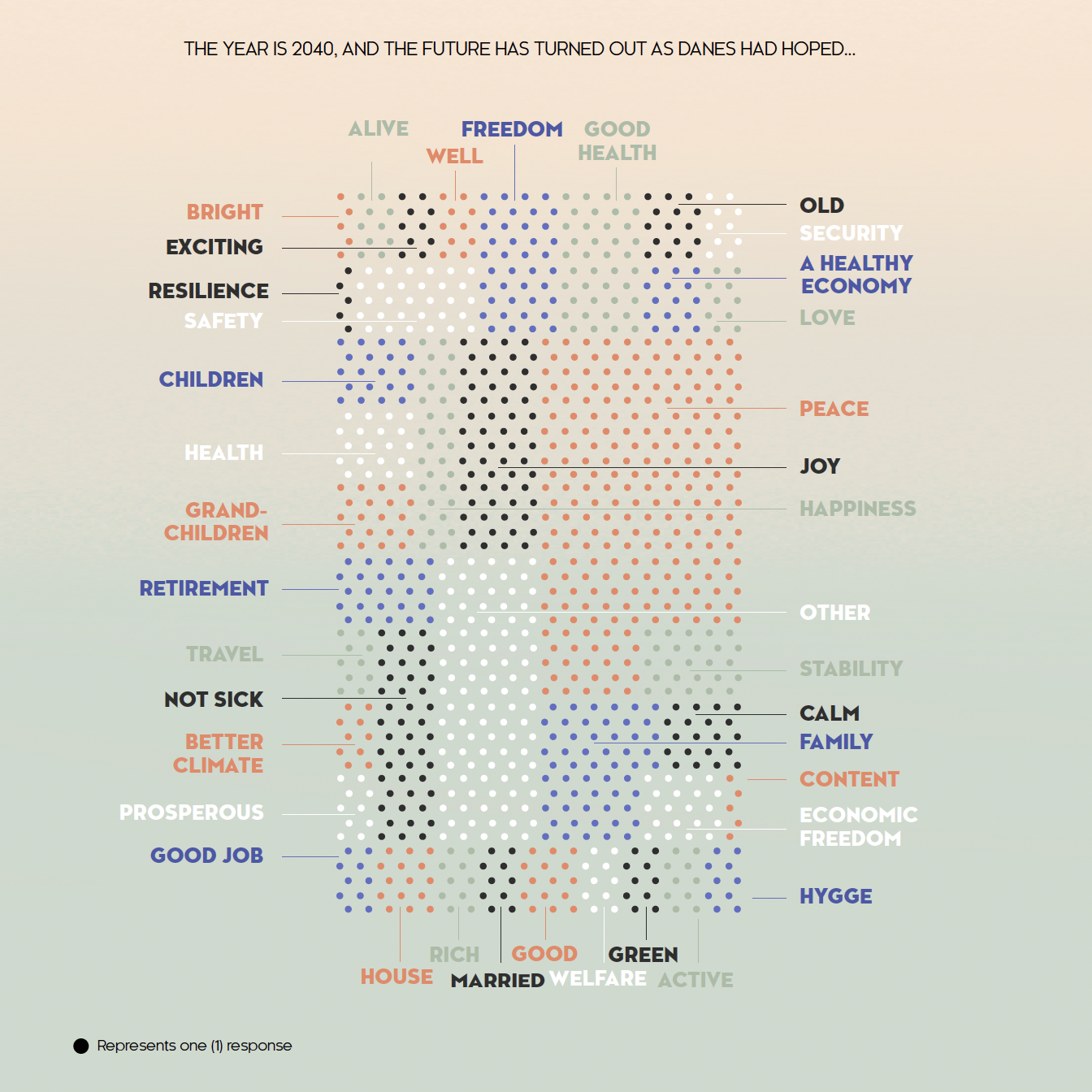
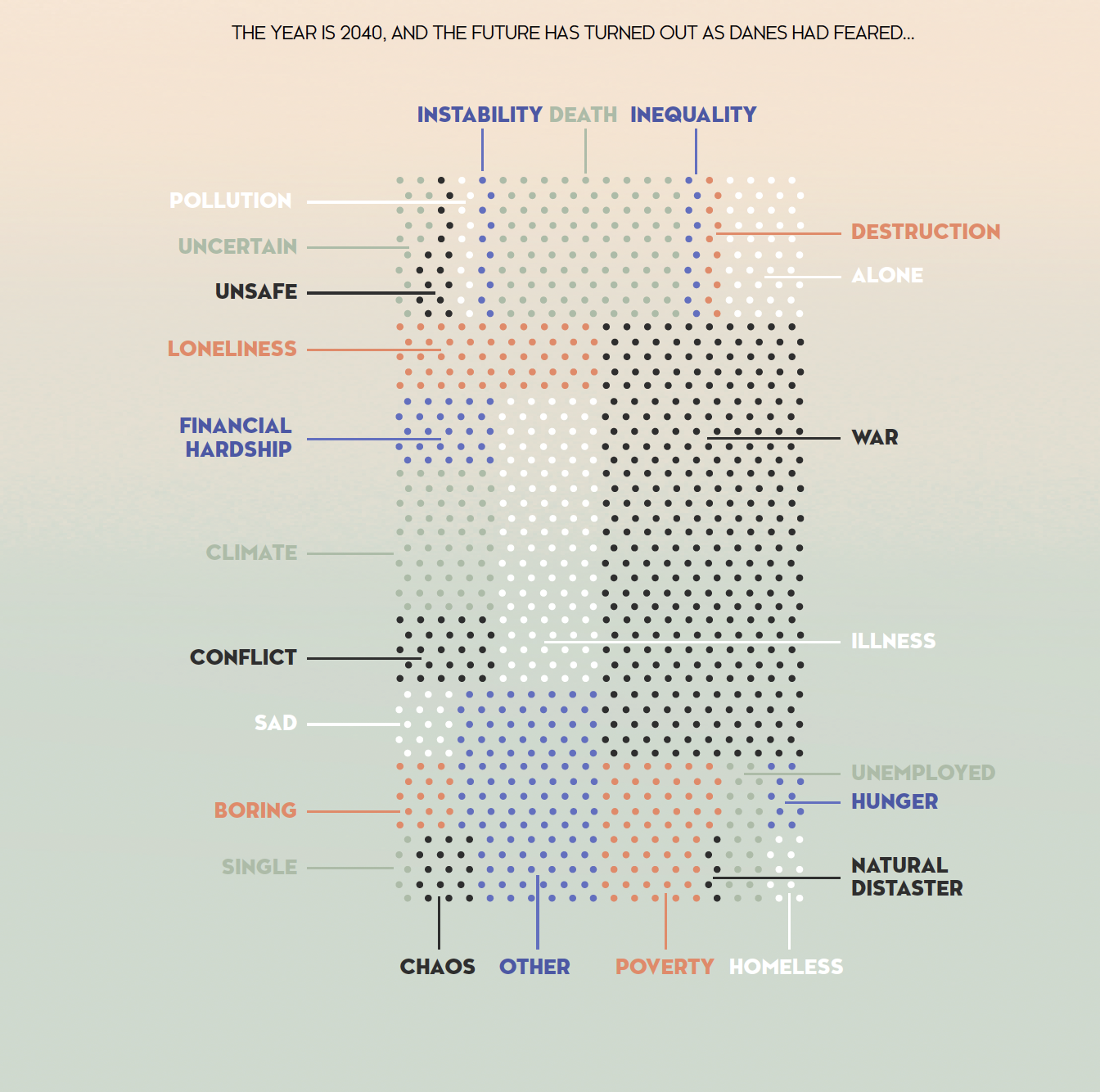
We asked Danes to write three words describing what the future looks like in 2040 if it has turned out as they both feared and hoped for. The answers relate both to personal themes – the respondents' own lives – and to the general state of the world in the future. We compiled the open responses in a model representing how often similar words and themes recur
Dot chart showing various aspirations for the year 2040, including happiness, health, freedom, family, peace, and economic stability, with each dot representing one response.
Dot graph with labels of fears for 2040 including instability, death, inequality, pollution, loneliness, war, illness, poverty, homelessness, and natural disaster.
The second part of the Futures Barometer examines how Danes perceive the relationship between politics and futures thinking. We explore how the population perceives the long-term orientation of political decisions, the political system’s ability to address future challenges, and the level of public support for initiatives that seek to strengthen the link between political decision-making and future-oriented thinking and tools (foresight).

Most Danes want more long-term thinking in politics

Politics is about the future – whether it concerns educational reforms, climate measures, immigration, fiscal policy, or any other area of political decision making.

But do Danes believe that the political decisions being made today take sufficient account of the long term? In this part of the Barometer, we focus on trust in political and institutional actors – and on people’s expectations of their ability to manage the challenges of the future.

63% of Danes believe that political decisions in Denmark are often characterised by short-term thinking, rather than efforts to create sustainable solutions for the next 10-20 years. This view is shared across the political spectrum – although, perhaps unsurprisingly, it is more strongly expressed among voters outside governing parties. Among Danes on each political wing, this applies to 69% (left-of-centre opposition) and 72% (right-of-centre opposition). But even among voters who would vote for a governing party, more than half (54%) agree.

Danes support measures to integrate foresight into political decision-making processes

Any political decision-maker would claim that political measures such as raising the retirement age or developing infrastructure plans to meet future needs are forward-looking – and with good reason. However, it is important to distinguish between, on the one hand, projecting future outcomes based on the logic of the present, versus on the other hand, exploring plausible futures that break with today's logic on key points. Developing truly future-oriented policies requires mastering and balancing both approaches.

Over the past decade, several countries have developed foresight capabilitieswithin their systems of political governance and public administration – thoughwith widely varying levels of ambition and purpose.

In Denmark, there is potential to learn from these examples and strengthen politicaldecision-making processes with tools that can help politicians and civilservants think about the future in a more long-term, explorative, and systematicway. However, such approaches have yet to be tested in practice. To gauge publicsupport for a such an initiative in Denmark, we asked Danes about their attitudestowards two specific measures – one hypothetical initiative at the national level andone existing initiative within the EU. In both cases, Danes responded positively.
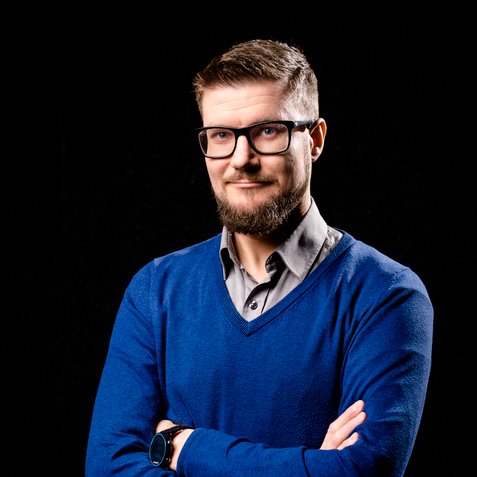
"Futures thinking doesn’t come naturally... it’s something you have to practise”
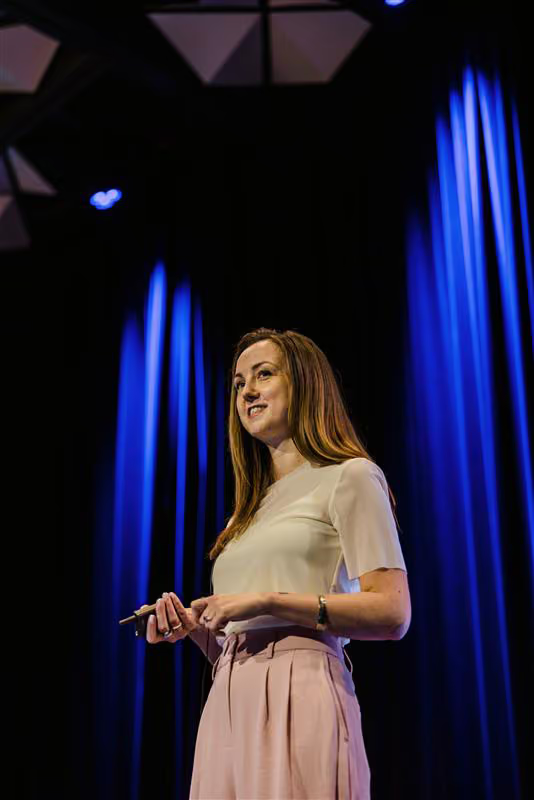
– Jukka Vahti, Senior Lead, Sitra
We cannot understand the future without also knowing the hopes, fears, expectations, and aspirations that both shape our outlook and impact our decisions. It may seem like a banal point, but it remains crucial one – because we still know very little about what images of the future that circulate among the public.

To begin filling in these blanks, the Finnish Innovation Fund Sitra launched the first edition of its Futures Barometer in 2019, revealing what sparks hope, what causes fear, and what inspires people across Finland. In 2023, CIFS followed suit with a Danish survey, taking inspiration from Sitra’s effort. Now, in 2025, both organisations have released their latest versions. So how do the results from these two Nordic countries compare?

To explore these questions, CIFS Head of Research & Publications Casper Skovgaard Petersen spoke with Senior Lead Jukka Vahti and Foresight Specialist Sanna Rekola from Sitra.

Reach Out

We have examined how Danes view the future - now we want to broaden our perspective to
the rest of the world.

The Copenhagen Institute
for Futures Studies is seeking partners who wish
to help develop the Futures Barometer into an
international survey that maps hope, fears, and
expectations across countries and cultures.
Toke Hanghøj
Director, Head of Communication & PR
tot@cifs.dk
+45 26 25 80 44
Søren Høyner
Web Coordinator
sth@cifs.dk
Bugge Holm Hansen
Director, Head of Tech Futures & Innovation
bhh@cifs.dk
+45 30 23 01 70
Sofie Hvitved
Director, Head of Media Futures & Innovation
shv@cifs.dk
+45 20 77 01 44
Adela Bisak
Advisor & Futurist
ab@cifs.dk
+45 33 11 71 76
Aron Szpisjak
Director, Head of Health
as@cifs.dk
+ 45 91 10 61 75
August Leo Liljenberg
Editor
aul@cifs.dk
+45 42 72 21 80
Caitlin van Bommel
Publications Staff Writer
cvb@cifs.dk
+45 33 11 71 76
Casper Skovgaard Petersen
Director, Head of Research & Publications
csp@cifs.dk
+45 42 53 32 13
Claus Sneppen
Associated Partner
csn@cifs.dk
+45 26 21 12 21
Gisela Eliasen
Associated Partner
gel@cifs.dk
+45 33 11 71 76
Karoline Sofie Lee
Advisor & Course Coordinator
kfl@cifs.dk
Klaus Æ. Mogensen
Associated Partner
klm@cifs.dk
+45 30 65 11 22
Kristian Mehlsen
Chief Operating Officer (COO), Senior Advisor & Futurist
kme@cifs.dk
+45 31 27 29 60
Magdolna Klára Kovács
Health Advisor & Futurist
mkk@cifs.dk
+45 33 11 71 76
Manya Lind, PhD
Senior Advisor & Futurist
ml@cifs.dk
+45 29 93 31 88
Martin Kruse
Director, Head of Sustainability and Resource
mkr@cifs.dk
+45 30 65 11 04
Monika Volgyi
Advisor & Futurist
mov@cifs.dk
Morten Grønborg
Associated Partner
mgr@cifs.dk
+45 50 45 00 35
Nicklas Larsen
Director, Head of Impact and Development
nl@cifs.dk
+45 31 75 03 85
Patrick Henry Gallen
Senior Advisor & Futurist
phg@cifs.dk
+45 50 20 48 34
Peter Aadal Nielsen
Scientific Advisor
pan@cifs.dk
+45 31 52 55 93
Sara Frostig
Art Director
sf@cifs.dk
Sean Pillot de Chenecey
Associated Partner
spdec@cifs.dk
+44 (0) 772 045 0163
Simon Fuglsang Østergaard
Director, Head of Strategic Foresight & Foresight Training
sio@cifs.dk
+45 31 26 83 26
Tamira Snell
Director, Head of Behaviour
tsn@cifs.dk
+45 26 79 05 85
Thomas Geuken
Associated Director
tg@cifs.dk
+45 28 10 08 38
Thor Svanholm Gustavfson
Senior Advisor & Project Lead
tsv@cifs.dk
+45 28 77 47 97
John Hansen
Associated Partner
+45 33 11 71 76
Lourdes Velasquez Cabrera
Associated Partner
lfvc@cifs.dk
+45 33 11 71 76
Tessa Finlev
Associated Partner
Bogi Eliasen
Fellow
Rodrigo Fernández García
Advisor & Futurist
rfg@cifs.dk
+45 93 94 73 89
Joseph Press
Associated Partner
jp@cifs.dk
Ask Ejlerskov
Advisor & Futurist
ale@cifs.dk
+45 28 19 38 46
Matt Klein
Associated Partner
Joanna Lepore
Associated Partner
Valentina Doorly
Associated Partner
Mikkeline Lykkesfeldt
Advisor
mily@cifs.dk
Torben Rene Uhrenholt
Associated Partner
tru@cifs.dk
Flemming Besenbacher
Fellow
Michael Johansson
Associated Partner
Lisa Di Giulio
Junior Advisor
ldg@cifs.dk
Giovanna Noronha
Junior Advisor
gn@cifs.dk
Anton Alfonsin Larsen
Junior Advisor
al@cifs.dk
Suus Hulsen
Junior Health Advisor
sh@cifs.dk
Ellen Impgaard Schou
Junior Advisor
eis@cifs.dk
Carsten Beck
Director & Futurist
cab@cifs.dk
+45 30 65 11 01
Anastasia Allanovna Rytkheu Nørager
Executive PA & Office Manager
ann@cifs.dk
+45 53 53 59 77
Lovisa Volmarsson
Senior Advisor & Futurist
lov@cifs.dk
+45 31 51 10 58
Lasse Jonasson
Chief Foresight Officer
lj@cifs.dk
+45 53 66 00 40
Helle Kallermann
CFO
hek@cifs.dk
+45 30 93 42 43
Nabil Ali Jaloud
Director, Head of Partnerships & Business Development
naj@cifs.dk
+45 31 31 13 22
Jonas Gissel Mikkelsen
Fellow
Daria "Dasha" Krivonos
CEO & Futurist
dka@cifs.dk
+45 29 32 59 31