Scenarios For Greenland

Deterrence, Dependence, or Capitulation?
The Arctic has long been viewed as a future arena of geopolitical competition and conflict. Renewed remarks by U.S. President Donald J. Trump about taking control of Greenland – a semi-autonomous, Indigenous governed territory within the Danish Realm – have brought that future abruptly into the present. They underscore the Arctic’s growing strategic importance as a defensive bastion, shipping corridor, and potential source of vast natural resources, while also straining relations between the United States and its closest allies. More fundamentally, they raise unsettling questions about whether a return to unconstrained Great Power politics is eroding long-standing international norms, institutions, and the rule of law.

Recent diplomatic efforts by Danish and Greenlandic leaders, supported by European allies, to reaffirm the territorial integrity of the Danish Realm and address U.S. concerns over Arctic security have so far failed to produce a clear resolution. Given the unpredictability of the Trump Administration and its increasingly hostile tone towards Europe, a swift or stable settlement appears unlikely.

To say that the stakes are high is an understatement. What is at risk is not only the lives and livelihoods of the Greenlandic people, but also the cohesion of the transatlantic alliance and the credibility of a rules-based international order – long underwritten by the United States itself. In this context of profound uncertainty, it is necessary to consider how the dispute over Greenland’s future might unfold.

The Copenhagen Institute for Futures Studies has therefore developed four scenarios outlining how the conflict over Greenland could end, and the geopolitical implications of each outcome.
Read Scenario Report

The Scenarios

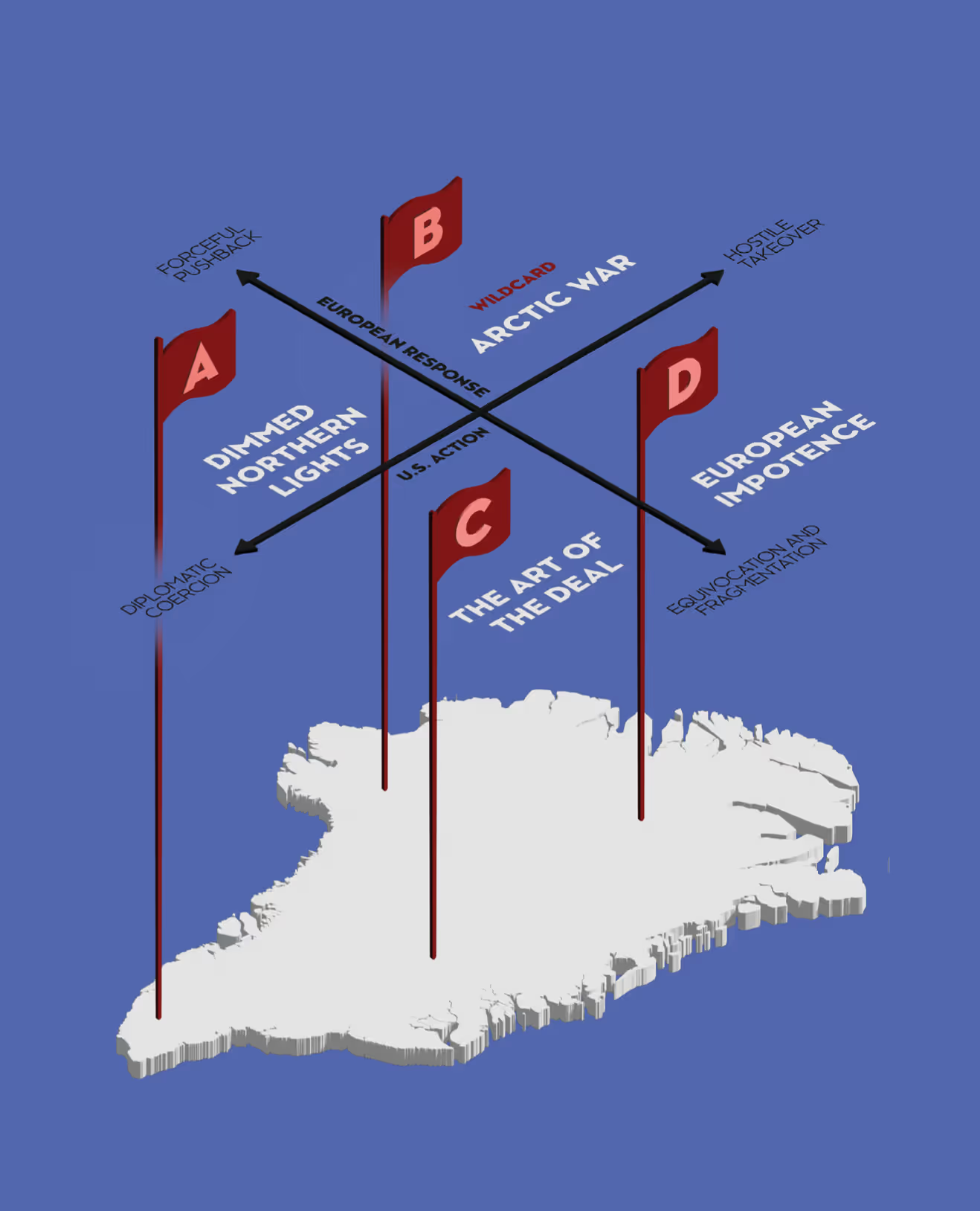
Diplomatic Coercion / Forceful Pushback
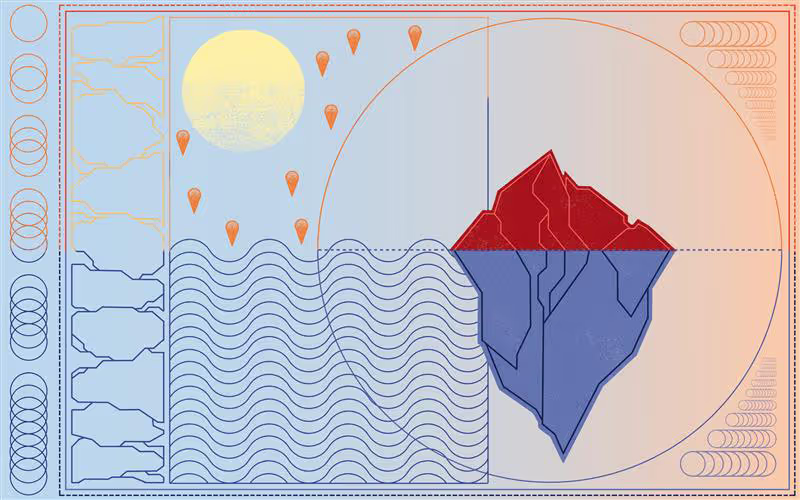
In 2026, the U.S. backed down on annexation ultimatums, but continued to pursue de facto control over Greenland’s critical infrastructure and strategic decisions through procedural “coordination,” security narratives, and deniable, but effective, economic pressure on Denmark. Europe and key NATO allies stood their ground, producing a tense equilibrium: Greenland stayed Danish territory but inside a tightened U.S.-defined security perimeter, while allied trust eroded, NATO weakened and European defence/tech autonomy accelerated.
Hostile Takeover / Forceful Pushback
The crisis detonated when U.S. troops invaded Greenland, rapidly overwhelming Danish and NATO forces. It was an act that symbolically ended the post–Cold War Atlantic order and fractured NATO. Europe pivoted from military dependence to economic retaliation and strategic decoupling (tariffs, divestment, tech de-risking), triggering transatlantic market turmoil, while Russia exploited allied disunity to force Ukraine into a punitive settlement. The shock accelerated Europe’s push for strategic autonomy: an EU turn toward energy security, tighter control over U.S. platforms, and a fast-tracked push toward deeper defence integration, including a unified European Army.
Diplomatic Coercion / Equivocation and Fragmentation
Greenland exited the Danish Realm via an independence vote and signed a U.S. COFA that traded generous grants and mobility rights for American control over defence and exclusive resource access. Washington achieved this through parallel coercion of Denmark and narrative capture inside Greenland (self determination and prosperity framing), while EU unity fractured and resistance collapsed. The aftermath was an alliance-wide trust shock: NATO survived but confidence in the U.S. as a benign guarantor eroded, Europe accelerated tech/data sovereignty and defence autonomy debates, and China and Russia exploited the return of overt power politics.
Hostile Takeover / Equivocation and Fragmentation
By spring 2026, the U.S. had begun re-militarising Greenland while tightening economic coercion and leveraging Europe’s digital dependence, forcing EU division and Denmark’s collapse into conceding sovereignty in exchange for economic security and “digital continuity” guarantees. The occupation was widely read as the death of legal internationalism, and it left Europe strategically paralysed by tech/platform entanglement while internal blame and anti-American sentiment surged. China and Russia exploited the transatlantic rupture amid volatile markets and a global reversion to raw power politics.


Authors

Daria Krivonos
Casper Skovgaard Petersen
Martin Kruse
Patrick Henry Gallen
Toke Hanghøj

Contact

Toke Hanghøj
Director, Head of Communication & PR
tot@cifs.dk
+45 26 25 80 44
Søren Høyner
Web Coordinator
sth@cifs.dk
Bugge Holm Hansen
Director, Head of Tech Futures & Innovation
bhh@cifs.dk
+45 30 23 01 70
Sofie Hvitved
Director, Head of Media Futures & Innovation
shv@cifs.dk
+45 20 77 01 44
Adela Bisak
Advisor & Futurist
ab@cifs.dk
+45 33 11 71 76
Aron Szpisjak
Director, Head of Health
as@cifs.dk
+ 45 91 10 61 75
August Leo Liljenberg
Editor
aul@cifs.dk
+45 42 72 21 80
Caitlin van Bommel
Publications Staff Writer
cvb@cifs.dk
+45 33 11 71 76
Casper Skovgaard Petersen
Director, Head of Research & Publications
csp@cifs.dk
+45 42 53 32 13
Claus Sneppen
Associated Partner
csn@cifs.dk
+45 26 21 12 21
Gisela Eliasen
Associated Partner
gel@cifs.dk
+45 33 11 71 76
Karoline Sofie Lee
Advisor & Course Coordinator
kfl@cifs.dk
Klaus Æ. Mogensen
Associated Partner
klm@cifs.dk
+45 30 65 11 22
Kristian Mehlsen
Chief Operating Officer (COO), Senior Advisor & Futurist
kme@cifs.dk
+45 31 27 29 60
Magdolna Klára Kovács
Health Advisor & Futurist
mkk@cifs.dk
+45 33 11 71 76
Manya Lind, PhD
Senior Advisor & Futurist
ml@cifs.dk
+45 29 93 31 88
Martin Kruse
Director, Head of Sustainability and Resource
mkr@cifs.dk
+45 30 65 11 04
Monika Volgyi
Advisor & Futurist
mov@cifs.dk
Morten Grønborg
Associated Partner
mgr@cifs.dk
+45 50 45 00 35
Nicklas Larsen
Director, Head of Impact and Development
nl@cifs.dk
+45 31 75 03 85
Patrick Henry Gallen
Senior Advisor & Futurist
phg@cifs.dk
+45 50 20 48 34
Peter Aadal Nielsen
Scientific Advisor
pan@cifs.dk
+45 31 52 55 93
Sara Frostig
Art Director
sf@cifs.dk
Sean Pillot de Chenecey
Associated Partner
spdec@cifs.dk
+44 (0) 772 045 0163
Simon Fuglsang Østergaard
Director, Head of Strategic Foresight & Foresight Training
sio@cifs.dk
+45 31 26 83 26
Tamira Snell
Director, Head of Behaviour
tsn@cifs.dk
+45 26 79 05 85
Thomas Geuken
Associated Director
tg@cifs.dk
+45 28 10 08 38
Thor Svanholm Gustavfson
Senior Advisor & Project Lead
tsv@cifs.dk
+45 28 77 47 97
John Hansen
Associated Partner
+45 33 11 71 76
Lourdes Velasquez Cabrera
Associated Partner
lfvc@cifs.dk
+45 33 11 71 76
Tessa Finlev
Associated Partner
Bogi Eliasen
Fellow
Rodrigo Fernández García
Advisor & Futurist
rfg@cifs.dk
+45 93 94 73 89
Joseph Press
Associated Partner
jp@cifs.dk
Ask Ejlerskov
Advisor & Futurist
ale@cifs.dk
+45 28 19 38 46
Matt Klein
Associated Partner
Joanna Lepore
Associated Partner
Valentina Doorly
Associated Partner
Mikkeline Lykkesfeldt
Advisor
mily@cifs.dk
Torben Rene Uhrenholt
Associated Partner
tru@cifs.dk
Flemming Besenbacher
Fellow
Michael Johansson
Associated Partner
Lisa Di Giulio
Junior Advisor
ldg@cifs.dk
Giovanna Noronha
Junior Advisor
gn@cifs.dk
Anton Alfonsin Larsen
Junior Advisor
al@cifs.dk
Suus Hulsen
Junior Health Advisor
sh@cifs.dk
Ellen Impgaard Schou
Junior Advisor
eis@cifs.dk
Mai Britt Romme
Executive Assistant
Mar@cifs.dk
Carsten Beck
Director & Futurist
cab@cifs.dk
+45 30 65 11 01
Anastasia Allanovna Rytkheu Nørager
Executive PA & Office Manager
ann@cifs.dk
+45 53 53 59 77
Lovisa Volmarsson
Senior Advisor & Futurist
lov@cifs.dk
+45 31 51 10 58
Lasse Jonasson
Chief Foresight Officer
lj@cifs.dk
+45 53 66 00 40
Helle Kallermann
CFO
hek@cifs.dk
+45 30 93 42 43
Nabil Ali Jaloud
Director, Head of Partnerships & Business Development
naj@cifs.dk
+45 31 31 13 22
Jonas Gissel Mikkelsen
Fellow
Daria "Dasha" Krivonos
CEO & Futurist
dka@cifs.dk
+45 29 32 59 31